Announcements

  1. Mill certificates: new Product Reference matching

    Improvement

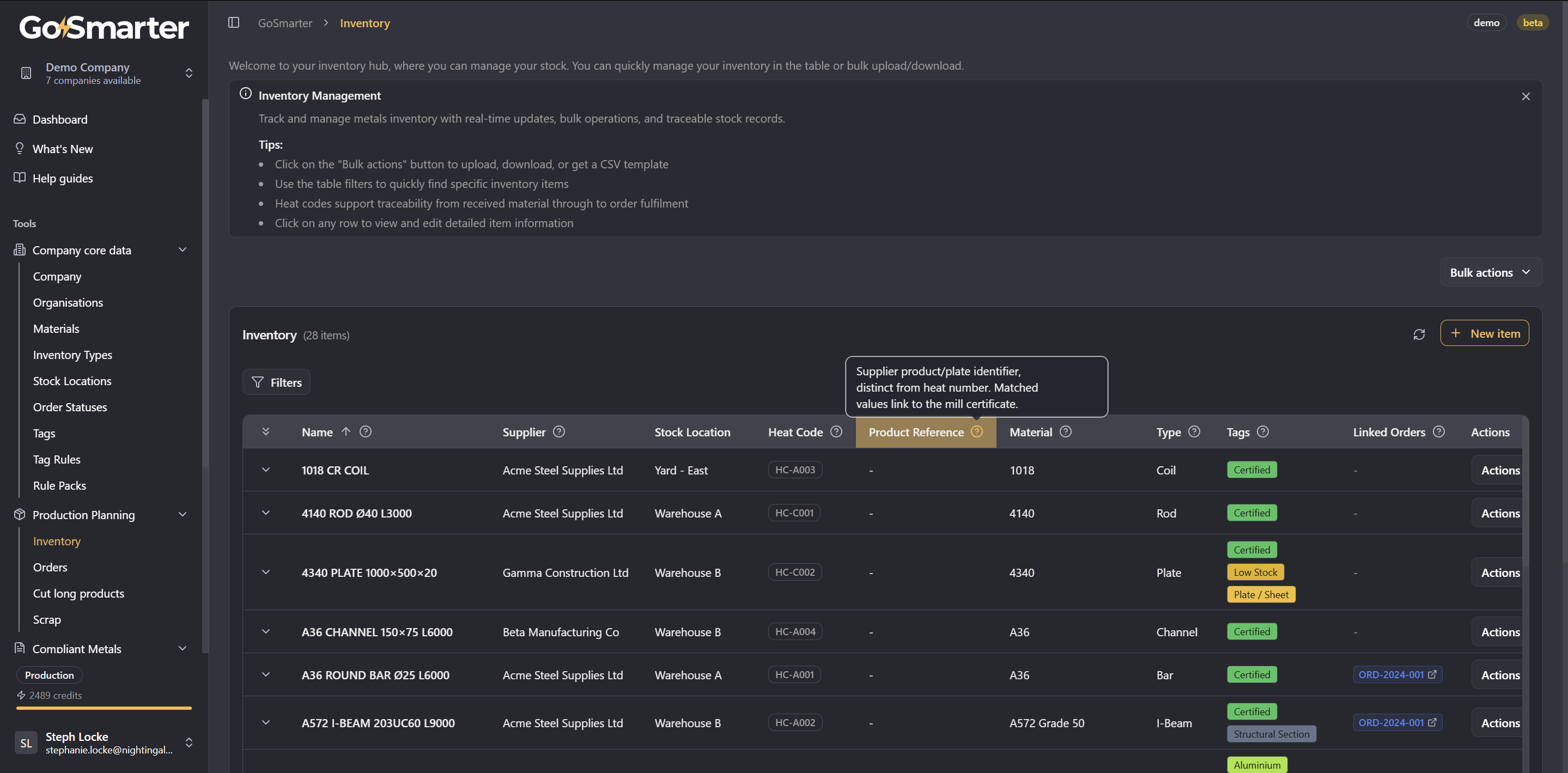
    We’ve shipped an upgrade to mill certificate ↔ inventory matching by adding Product Reference as an alternate key alongside heat codes. This matters for people who receive certificates for individual plates etc. that could be from the same heat code as many other items.

    What’s new

    • Inventory and mill-certificate heats now support Product Reference.
    • Matching logic is heat-first: Heat-code matches always take precedence when it is completed for an inventory item. Product Reference is used when no heat match is available. This means no unexpected changes for existing data.
    • Tag rules can include product-reference matches (without double-counting when both keys match the same heat).
    • Product Reference is now incorporated into imports and exports of inventory, used for matching certificates, and is included where present in certificate packs.
    image
  2. Now you can export all your mill cert data

    Improvement

    Just a quick update to say that now you can export all your mill certificate / material test report data as CSV with ease. This is available as a bulk action on the mill cert summary page. Your data is always yours - you should be able to download it easily.

    2

  3. Rule Packs: automatic standards-compliance checks for your inventory, mill certs, and orders

    New Feature

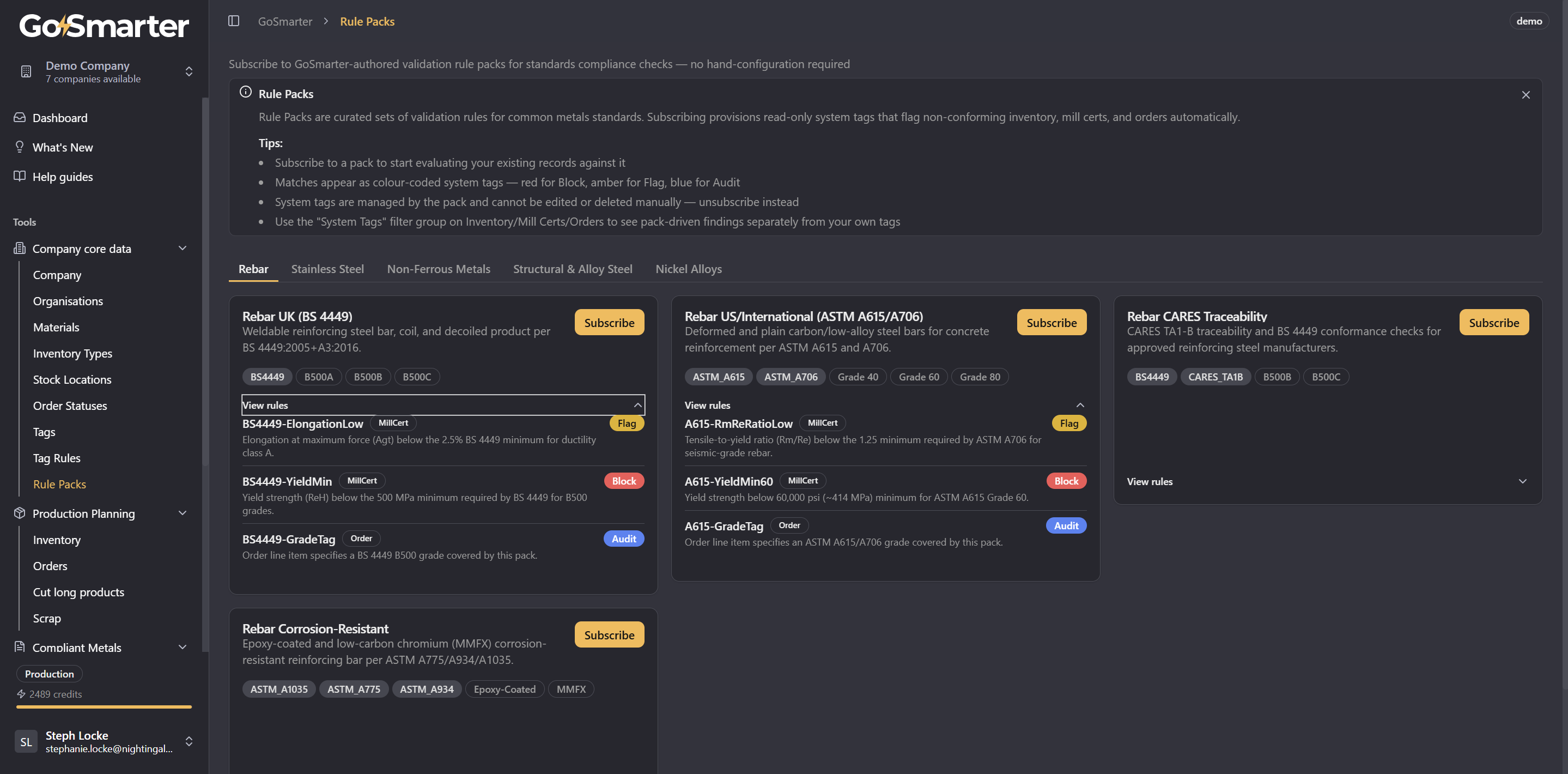
    You can now subscribe to Rule Packs, which are curated, ready-to-use compliance checks for common metals standards, with no manual rule setup required.

    Head to Company core data → Rule Packs to browse 15 packs across 5 categories:

    • Rebar (BS 4449, ASTM A615, CARES traceability)
    • Stainless Steel (EN 10088)
    • Non-Ferrous Metals
    • Structural & Alloy Steel
    • Nickel Alloys

    image

    Subscribe to a pack and it automatically flags non-conforming inventory, mill certificates, and orders, no configuration needed. Matches show up as colour-coded tags right where you already work:

    • 🔴 Block: critical non-conformance
    • 🟠 Flag: needs review
    • 🔵 Audit: informational

    Every pack shows exactly which standards and grades it covers, and you can expand any pack to see its full rule list before subscribing.

    image

    A few things to know:

    • Pack rules are read-only and managed by GoSmarter, so they stay consistent but you're always in control: unsubscribe anytime, or delete individual rules if one doesn't apply to you.
    • Use the new System Tags filter on your Inventory, Orders, and Mill Certs pages to see pack-driven findings separately from your own custom tags.
    • This is a first release of our rule content so we're continuing to refine the rules against exact standard clause text, so treat matches as a helpful first pass rather than a final compliance determination for now.
    • These currently depend on our IDs for grades and material types - we're working on making them more flexible.

    Give it a try and let us know what other standards or grades you'd like to see covered next.

  4. Clearer mill cert uploads at scale

    Improvement

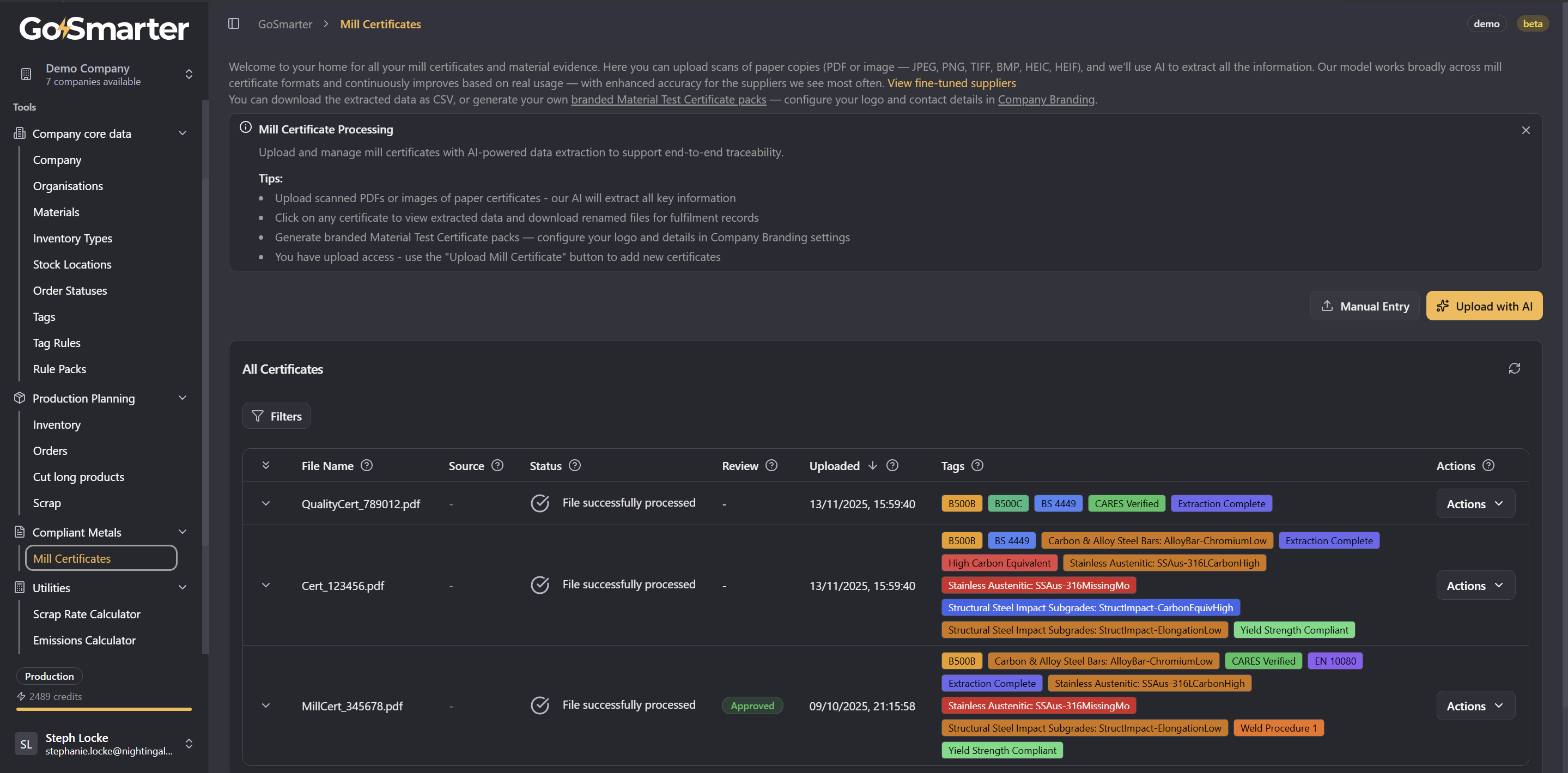
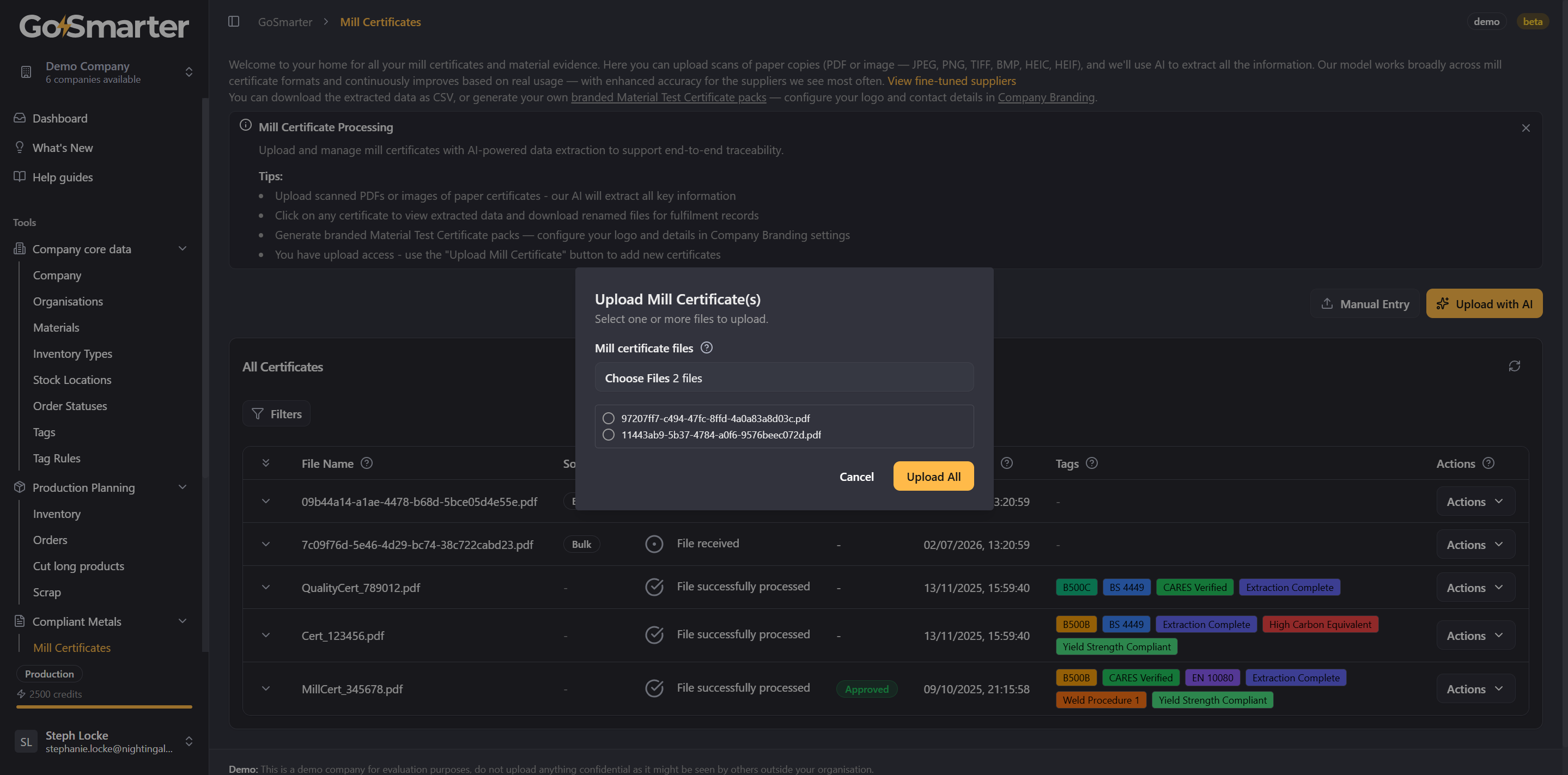
    Uploading mill certificates in bulk is faster to follow and easier to trust. You can now see where certificates came from, track progress file by file during multi-file uploads, and get clearer feedback if upload limits are hit part-way through.

    • Multi-file uploads now show per-file progress, so you can see what’s completed and what’s still running
    • Bulk uploads are grouped together and shown as Bulk in the mill cert summary table
    • Direct one-off uploads are clearly shown separately
    • If rate limits are reached, uploads stop gracefully with a partial-success message so you know what made it through
    • Archive (zip file) source labelling is in place and rolling out as part of upcoming archive workflows

    Who benefits: teams uploading lots of certificates, especially when handling large batches and needing better traceability.

    image
  5. Handle material test report images

    Improvement

    Whilst PDF is the Portable Document Format, sometimes people send you mill certificates and material test reports as images. You're getting them on email, from WhatsApp, or your Goods In person is taking a quick snap whilst they're trying to get the container unloaded. In these instances, we used to cause extra work by making you convert the certificates to PDFs and we hate making you do extra work! Our whole thing is helping you spend less time on admin afterall.

    We now support common image file formats for both manually uploading certificates or being uploaded and automatically processed by our AI. You can still get renamed downloads the way you're used to and the data can still be incorporated into your own branded certificates so there's no change in what you can do once you've got the certificate in your hands, except it's now easier if someone's sent you an image.

  6. Manage inventory based on material properties

    Improvement

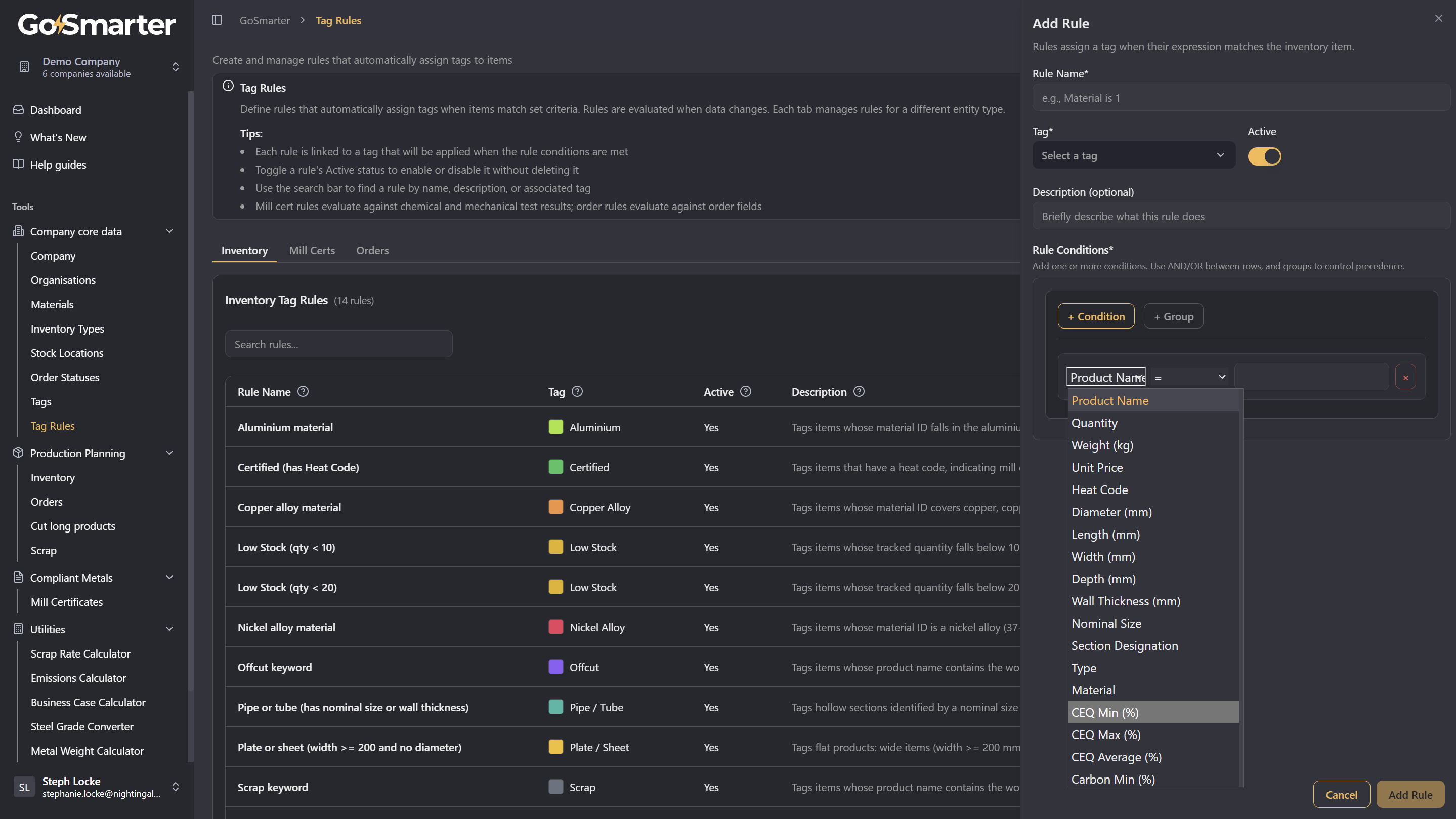
    We've just extended the rules engine for inventory to allow the use of values from linked mill certificates / material test reports for heat codes associated to an inventory so you can ensure you're always picking the right stock for the job.

    This works whether you've got a single heat code or multiples for a given stock line, by providing min, max, and average options for fields from the mill certificates. So for instance, you stock steel and it must always have a CEQ of more than 0.4 for a specific weld, you can create a rule for the inventory for the weld procedure that verifies the CEQ min % i.e. the smallest value for the matched heat codes, is greater than or equal to 0.4. when this condition is met, the inventory gets the tag for the weld procedure.

    image

  7. Auto-tag your mill certs and orders too

    Improvement

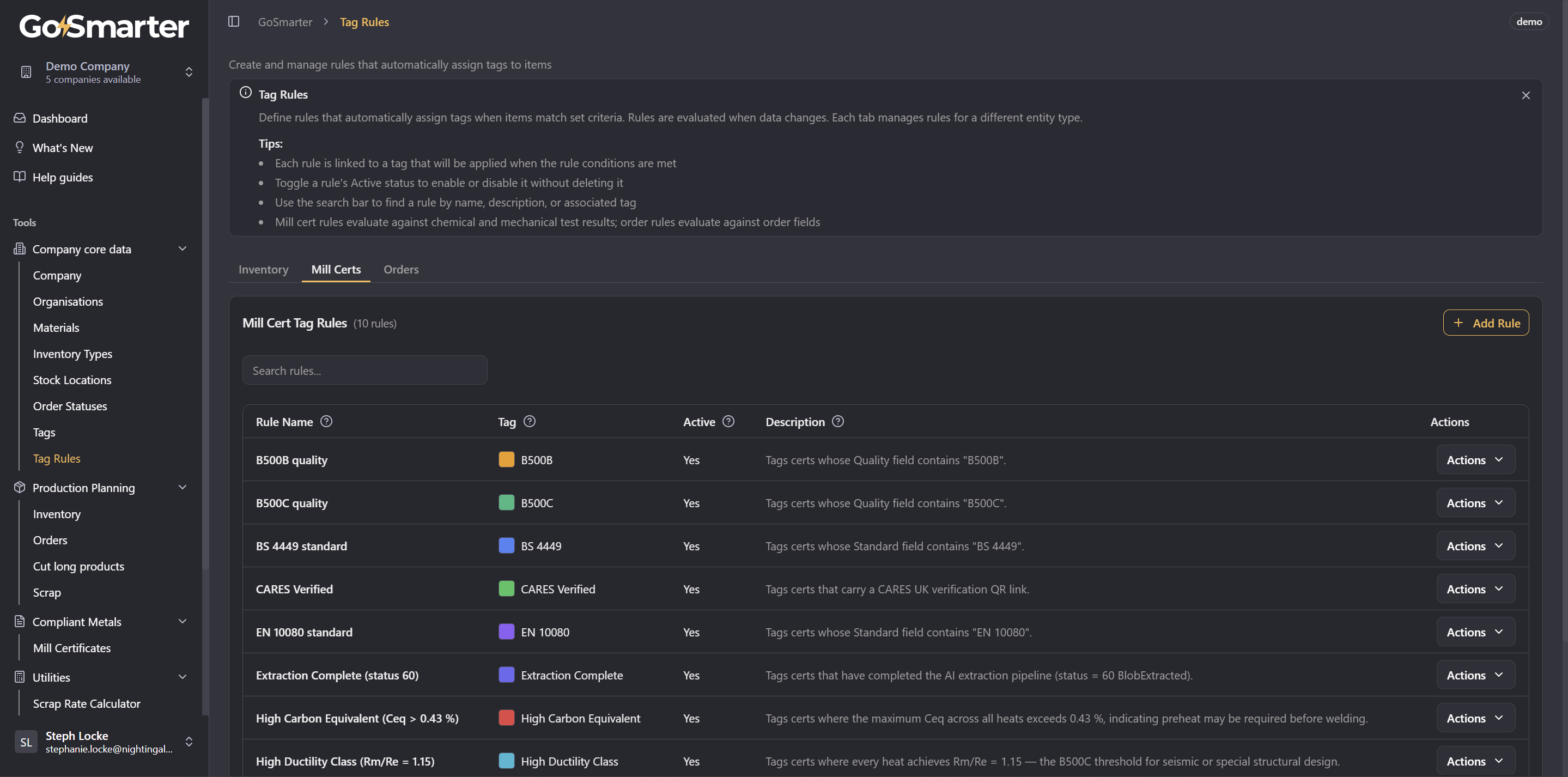
    Until now, tag rules were limited to inventory items - useful, but only part of the picture. Your mill certificates and orders were still being kept in everyone's heads.

    Now tag rules cover all three. Head to Configuration → Tags and Configuration → Tag Rules where you'll find Inventory, Mill Certs, and Orders sitting together on the same pages.

    For mill certs, you can write rules against any extracted value like standard (BS 4449, EN 10080), grade (B500B, B500C), carbon equivalent, ductility ratio, yield strength, etc. For orders, rules fire on status, quantity, diameter, length, site, and customer.

    Rules apply automatically whenever a certificate is processed or an order is updated, no manual trigger needed.

    image
  8. Connect your own scripts and tools to GoSmarter

    Improvement

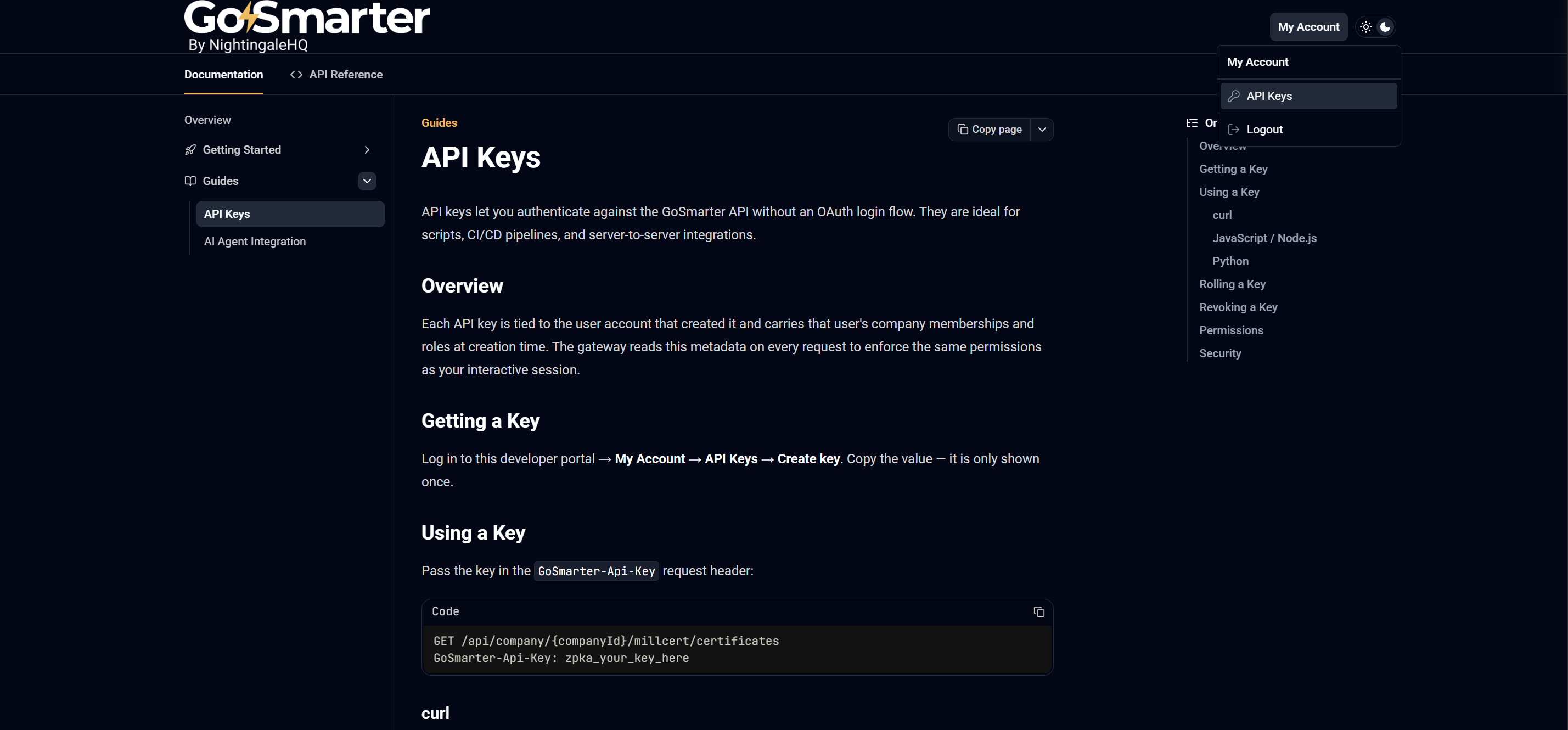
    If you want to pull inventory data, push mill certs, or wire GoSmarter into your own tooling, you've had to jump through the full OAuth login flow every time. That's fine for an interactive session, not great for a cron job.

    You can now create API keys straight from the developer portal:

    1. log in at api-docs.gosmarter.ai, go to My Account → API Keys, and hit Create.
    2. The key is shown once, so copy it somewhere safe. Each key carries your company

    memberships and roles at creation time, so it respects the same permissions

    as your normal login.

    Remember: no vendor should make your data hard to get so everything you can do in GoSmarter, you can do via API.

    The portal also has a quick start guide and code snippets for curl, JavaScript, and Python to get you going. You can manage your keys and use them to access the API via the portal for testing things out.

    💡 This also greatly improves the ease of use of our MCP server so you can have your own AI interfaces to GoSmarter, using them as natural language interfaces or rapid writers of integrations with your other systems.

    We support customers during onboarding and going forward with steps to integrate GoSmarter with other applications and you can read more about different approaches in our Integration Strategy guide.

    image
  9. Manual Tag Management

    Improvement

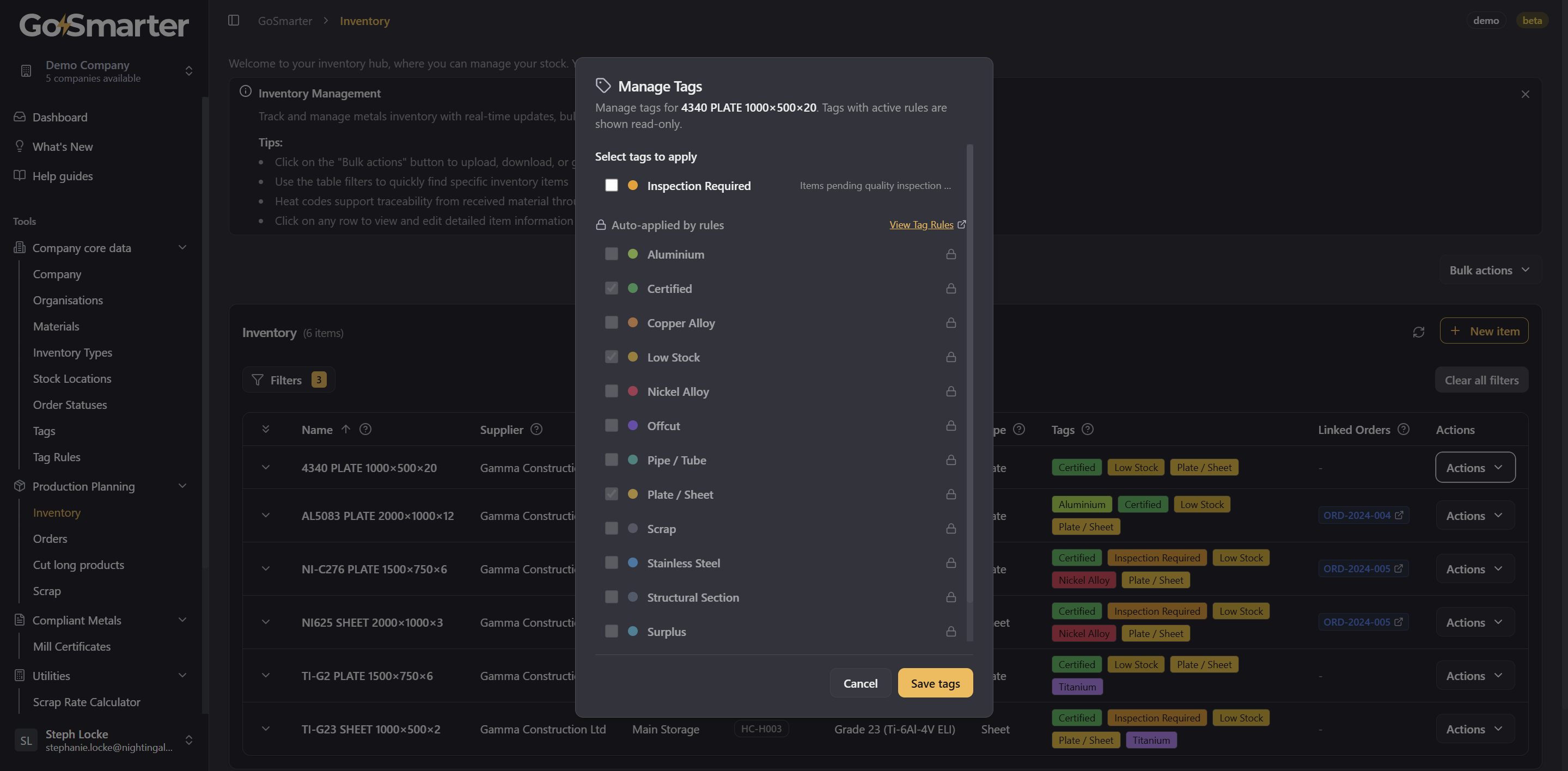
    Manage tags directly from your inventory table. You can now manually apply and remove tags on any inventory item without leaving the inventory view. The new "Manage tags" modal replaces the old per-row "Apply tag rules" button, giving you a clearer, more powerful interface for organising your stock.

    What's new:

    • Open Manage tags from any inventory row to see all available tags for your company in one place. Check or uncheck tags to apply or remove them instantly.
    • Tags controlled by active auto-apply rules are shown with a lock icon and marked read-only so you always know which tags are being managed automatically and which are yours to control.
    • A "View Tag Rules" link inside the modal takes you directly to the Tag Rules page if you want to change how rules  behave.
    • Long tag names no longer overflow, they truncate cleanly with a tooltip showing the full name on hover.
    • Rule-governed tags are clearly indicated via tooltip on hover or keyboard focus, making the interface fully accessible without a mouse.

    Why it matters: Previously, manual tag assignment required working around auto-apply rules, with no visibility into which tags were rule-controlled. Now you get a single, honest view of every tag on an item - what's automatic, what's manual, and how to change either.

    image
  10. Send cleaner order packs with certificate PDFs

    New Feature

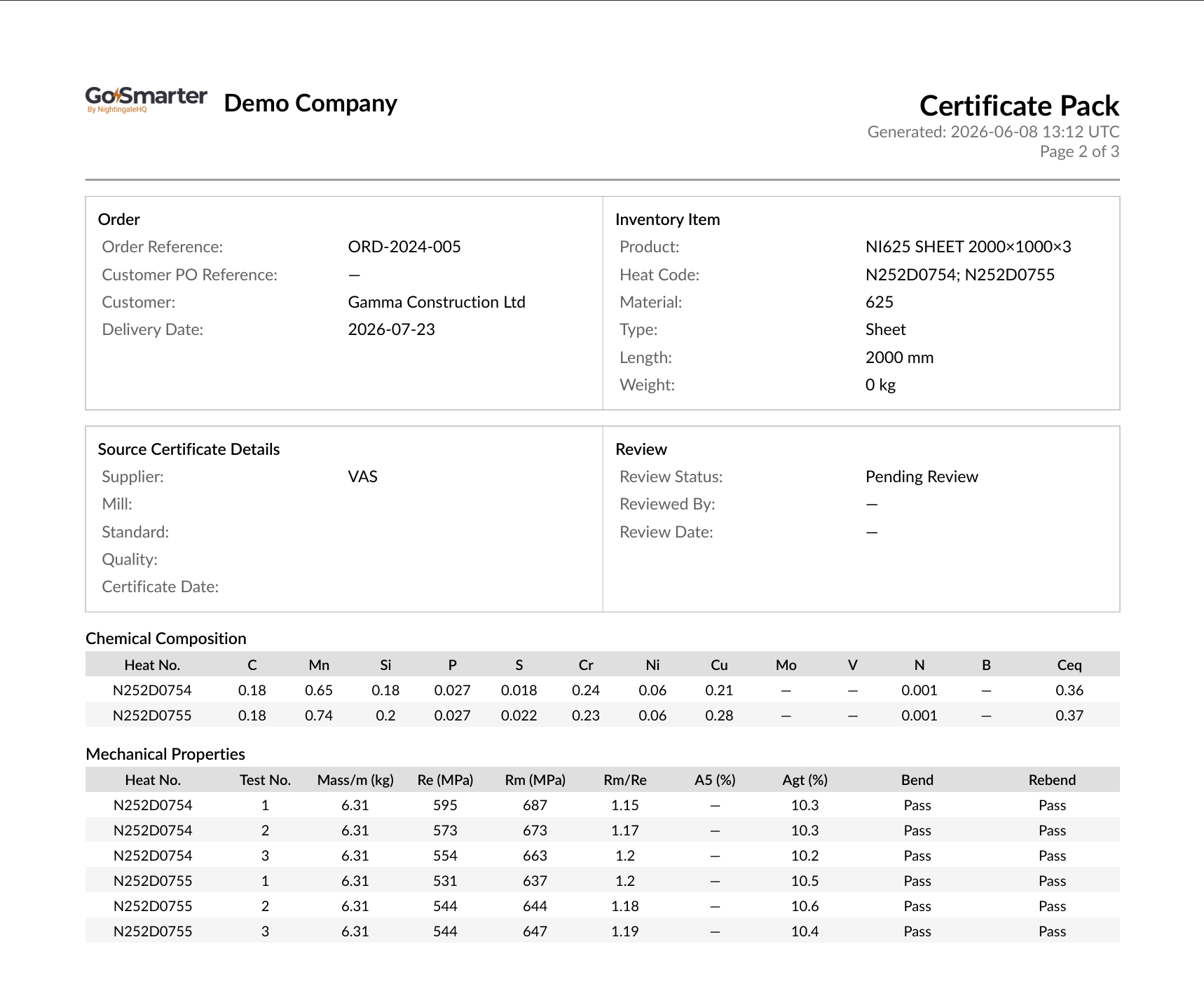
    Chasing order context and matching mill certificates usually meant hopping between screens, exports, and individual records. Now you can generate a proper certificate pack PDF for an order, ready to share without the extra faff.

    Use Generate Certificate Pack from the Actions menu in the Orders list, or from Bulk actions on the Order Details page in Line Items.

    The pack includes:

    • a cover page with the order details, including Customer PO Reference
    • one page per linked inventory item (no associated stock, no page)
    • mill certificate details where a certificate is matched
    • a clear notice where no mill certification is on record

    This works with minimal effort on your part. Data only ever gets entered once.

    1. Mill certs come in, you upload them with AI
    2. You log the inventory, including the heat code
    3. You reserve the stock against the order, when you're planning production
    4. You export the PDF when you're shipping the order (or parts of it)
    image